




Most people expect meteors to look white.
Then suddenly a bright green fireball crosses the sky. Sometimes it flashes blue, orange or even deep red before disappearing into darkness. For a few seconds the entire atmosphere feels unreal, almost cinematic.
That moment is exactly why people become obsessed with meteor colors.
Across social media and astronomy forums, thousands of people search questions like:
- why was the meteor green,
- what does a blue meteor mean,
- red fireball in sky meaning,
- orange meteor spiritual meaning,
- why do meteors change color.
The truth is that meteor colors are not random. Both science and spiritual symbolism give surprisingly fascinating explanations for what people see in the night sky.
Could Meteor Colors Reveal What They Are Made Of?
Scientifically, yes.
The color of a meteor is usually connected to the elements burning inside it as it enters Earth’s atmosphere at extreme speed. The heat becomes so intense that minerals and metals begin glowing in different colors.
Different chemical compositions create different visual effects.
That is why some meteors appear:
- green,
- blue,
- orange,
- yellow,
- red,
- purple,
- white.
The atmosphere itself also affects the final color people see from the ground.
Why Are Green Meteors So Commonly Reported?
Green meteors are among the most famous fireballs people witness.
They often appear brighter and more dramatic than ordinary shooting stars, which is why videos of green meteors frequently go viral online.
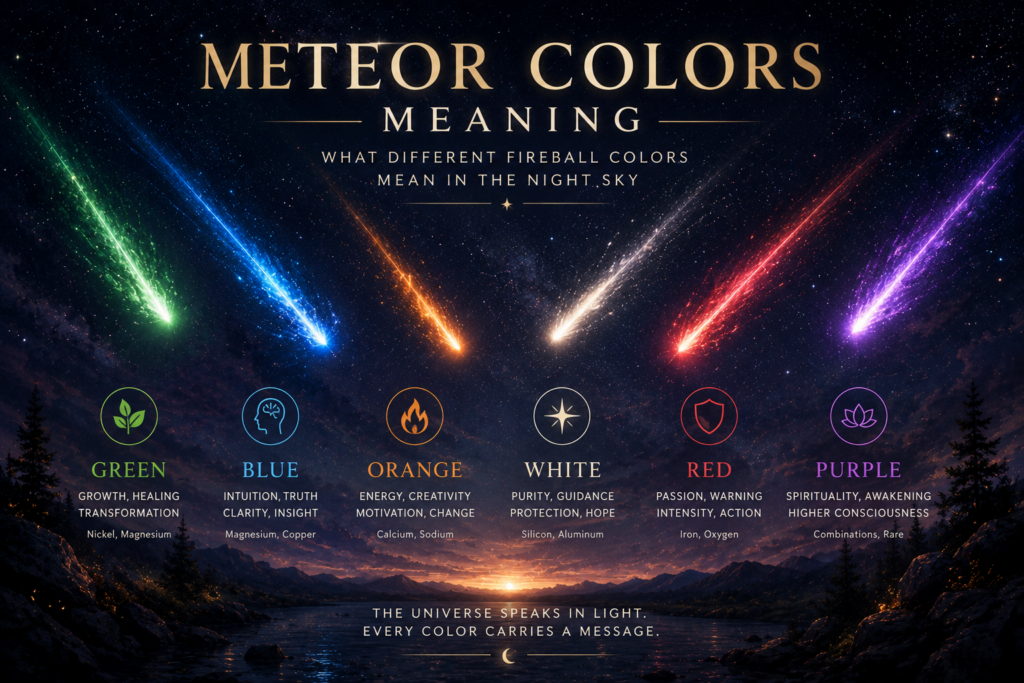
Scientifically, green colors are commonly linked to burning nickel or magnesium particles interacting with oxygen in the atmosphere.
But spiritually, green meteors are often interpreted very differently.
Many people associate green cosmic light with:
- transformation,
- emotional renewal,
- powerful change,
- spiritual awakening,
- energy shifts.
Because green is strongly connected to nature and growth symbolically, green meteors often leave a strangely emotional impression on people who witness them.
What Does A Blue Meteor Mean?
Blue meteors usually burn extremely hot.
In astronomy, blue coloration often indicates intense energy and very high temperatures during atmospheric entry. Some scientists associate blue fireballs with magnesium-rich material or especially fast-moving meteors.
Visually, blue meteors tend to look more surreal than natural. They often appear almost electric against the dark sky.
Spiritually, blue cosmic events are commonly linked to:
- intuition,
- clarity,
- inner truth,
- communication,
- emotional awareness.
People who witness blue meteors often describe the experience as strangely calming despite the intensity of the light itself.
Why Do Some Meteors Appear Orange Or Red?
Orange and red meteors usually appear lower and slower in the atmosphere compared to brighter white or blue fireballs.
Scientifically, red and orange tones can result from:
- iron content,
- atmospheric friction,
- lower burn temperatures,
- dust particles interacting with air.
But emotionally, these colors create a very different atmosphere in the sky.
Red meteors often feel unsettling or dramatic because humans naturally associate red light with danger, warning or intensity. Throughout history, many cultures interpreted red celestial events as powerful omens or signs connected to major change.
Orange meteors, meanwhile, are often associated with warmth, energy and transformation.
Could Meteor Colors Have Spiritual Meanings?
For thousands of years, people believed celestial events carried messages.
Long before modern astronomy existed, meteors were often viewed as spiritual signs connected to gods, destiny or major world events. Even today, many people instinctively search for symbolic meaning after witnessing an unusual fireball.
Modern spiritual interpretations vary widely, but meteor colors are commonly associated with emotional symbolism.
People often interpret:
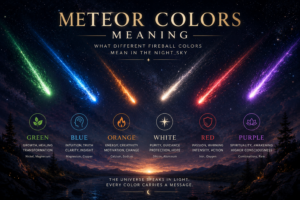
- green meteors as growth,
- blue meteors as intuition,
- red meteors as warning or passion,
- white meteors as purity or guidance,
- purple meteors as spiritual awakening.
Whether symbolic meanings are real or psychological, the emotional effect on people is undeniable.
Why Do Fireballs Feel So Emotional To Witness?
Because they feel temporary and uncontrollable.
Unlike stars or planets that remain stable in the sky, meteors appear suddenly and disappear within seconds. The human brain reacts strongly to rare, unexpected light events, especially against darkness.
Large fireballs can also trigger awe responses psychologically. Researchers studying human reactions to cosmic events found that massive natural phenomena often create feelings of wonder, fear or existential reflection.
That emotional intensity is one reason meteor videos spread so quickly online.
People are not only reacting to the science.
They are reacting to the feeling.
Are Purple Meteors Real?
Rarely, but yes.
Purple meteors are extremely uncommon and usually result from combinations of atmospheric effects, camera distortion or unusual mineral compositions. Many reported “purple meteors” appear briefly during transitions between blue, red and white light.
Because the color is so unusual, purple meteors became heavily associated with spirituality online.
They are often interpreted as symbols of:
- higher consciousness,
- intuition,
- psychic energy,
- spiritual connection,
- cosmic transformation.
Whether scientifically rare or spiritually symbolic, purple meteors remain some of the most visually fascinating fireballs people can witness.
Why Are People So Obsessed With Cosmic Events Right Now?
Interest in cosmic symbolism has exploded online over the last few years.
Moon phases, eclipses, planetary alignments, meteor showers and angel numbers all became deeply connected with emotional self-reflection culture across TikTok, YouTube and spiritual communities.
People increasingly search for meaning during uncertain periods of life. Cosmic events feel larger than everyday reality, which makes them emotionally powerful.
Meteor colors combine science and mystery perfectly.
That combination keeps people searching.
Meteor colors are far more than random flashes in the night sky.
Scientifically, they reveal the minerals, speed and atmospheric interaction of objects burning above Earth. Spiritually, many people interpret these rare cosmic lights as symbols connected to transformation, intuition and emotional change.
Maybe that is why witnessing a fireball feels unforgettable.
For a few seconds, the sky stops looking ordinary.
And people instinctively feel like they just saw something meaningful.